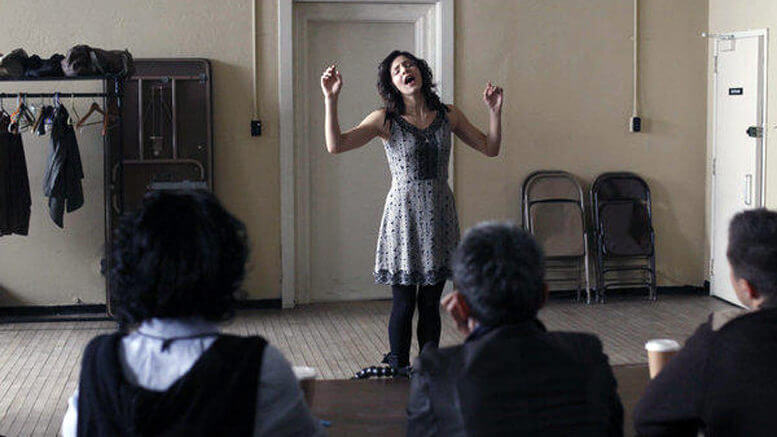
So it's an impressive coup of having-its-cake-and-eating-it-too that the Flea Theatre, a downtown stalwart with a reputation for new, exciting, often weird-as-hell work, has pulled with its production of Chicago playwright Sean Graney's These Seven Sicknesses. The work, a 4.5-hour marathon adaptation of Sophocles's seven extant plays, has proven a great hit for the Flea, playing to packed houses and currently extended as far as the theater's schedule allows. And yet, thanks both to both Graney's (mostly) irony-free embrace of the tragic sensibility, and to director Ed Sylvanus Iskandar's briskly paced production, These Seven Sicknesses is also an engrossing contemporary work that deserves attention.
One doesn't need to be a Greek purist to find reasons to gripe with these adaptations, of course. There's a multitude of Graney's alterations that have potential to turn off a familiar audience — the gods are entirely excised from the proceedings, the traditionally off-stage violence is realized onstage with exquisite gore, the role of the chorus is minimized, characters are often robbed of the agency they have in Sophocles (most notably Oedipus in In Colonus), just to name a few. But even at the points where the show might offend most grievously, the experience involves grappling intellectually with the fundamental elements that continue to make Sophocles so resonant. Graney maintains throughout the basic sensibility of direct and unsubtle conflict, where characters are less realistic individuals and instead intense depictions of recognizable human qualities. And even the most persnickety purist will surely enjoy the experience of the multiple crossovers that these remaining plays employ, particularly in terms of the characters who appear in several works (my favorite actors of the night worked in this way — Stephen Stout as Creon and Seth Moore as Philoktetes). In the end, one would be hard pressed to suggest that this enterprise was born from anything other than a fundamentally affectionate desire to dive into these archaic plays to rediscover their core. And the atmosphere that Iskander has crafted — in which the audience during the two long intermissions is served Thai dinner and cupcakes while the cast of 38 mingle throughout — attempts to capture a sense of what these full-day Greek theatrical events might have meant to the community that the plays were meant to celebrate.
Ultimately, though, what does limit the show's profundity from reaching full potential is a too-common reliance on comedy and an unfortunate reticence to take itself too seriously. To some extent, all of this helps the evening pass more quickly, thanks both to the jovial atmosphere engendered by Iskander and the meta commentary that pops up throughout Graney's script, the best example of the latter being the amusingly repetitive use of Tommy Crawford as the Messenger so common in Greek tragedy. All good fun, but nevertheless a hedging of bets — Graney comes close so often to achieving a contemporary take on the interminable descent into mankind's irrelevance before the Fates, that unceasing wellspring of Sophocles's brilliance, and yet one can see Graney's common reluctance to stay there too long without undercutting the play with a joke or two. Maybe this makes the evening better, more commercial, more fun — that's to you to decide — but undoubtedly it lessens an emotional impact that he otherwise shows himself capable of realizing.
So many words, and still so much to say. There are long-form fights and nightmarish visions, there are scenes of despair and contemplations of heroism, and there are a ton of wonderful moments in These Seven Sicknesses that you'd be a fool to miss. It's something for both patrons of the classical form and adventurers of the fringe, and it's a damn nice testament to the endurance of theatricality as a mirror to the human struggle.
These Seven Sicknesses; Written by Sean Graney; Directed by Ed Sylvanus Iskander; The Flea Theatre; 41 White Street; 212-226-0051; www.theflea.org. Through March 4.